> LOGIN: INTRODUCTION
Before high-speed broadband and voice chat became the standard that it is today, the 1990s was a wild and experimental frontier, testing the waters for what online gaming is capable of. There is the classic screech of a connecting modem, the introduction and rise to popularity of LAN parties, and the birth of the first truly virtual communities. This site documents the rise of online gaming during the 1990s, analyzing how titles like Ultima Online were able to allow users to live in their own virtual space and create their own digital image.
> SYSTEM_ANALYSIS: THE_MUD_ERA
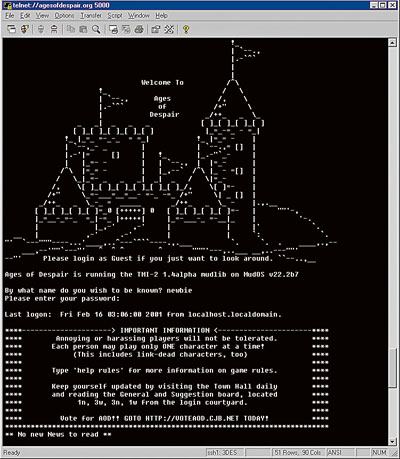
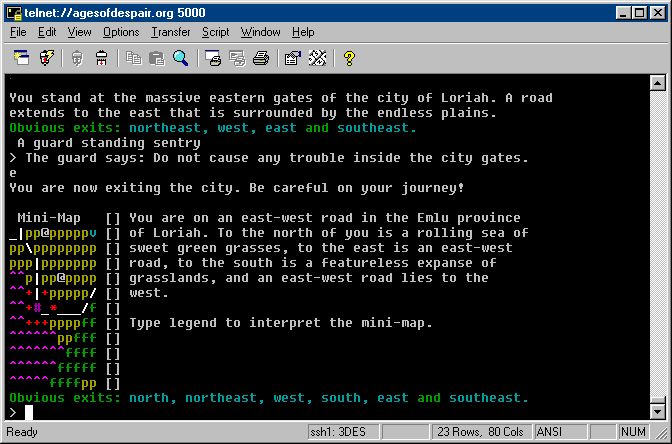
Before hit games such as Quake and EverQuest, gaming on the internet was very dull. During the early 1990’s, multi-user dungeons (MUD) were the go-to for internet gaming.These, typically text-based or storyboarded games, were commonly combinations of different genres. You had RPG elements, interactive storytelling, hack and slashing, and even pvp. Because these games were mainly blocks of text on a screen, players had to completely rely on social contracts. These were the initial origins you could say, which led to the classification of the term “Gamer.”
The Login Screen |
In-Game View |
Fig 1 & 2. The interface of 'Ages of Despair'. The login screen (left) and gameplay screen (right) relies on text descriptions.
In 1996, researcher and game developer Richard Bartle published Hearts, Clubs, Diamonds, Spades: Players who Suit MUDs. Within this text, Bartle argued that anyone and everyone who logged into the internet could be placed into 4 distinct categories:
- Achievers: Players who dedicated themselves to gaining points, leveling up, and completing the game.
- Explorers: Players who traverse maps and worlds, discovering "easter eggs" or hidden bugs.
- Socializers: Players who enjoyed the social aspect, often treating the game as a "chat room."
- Killers: Players who enjoyed causing distress and gained enjoyment from imposing themselves on others. Commonly today known as "griefers."
Before we knew it, there were already distinct social structures forming early on in online gaming's history, many of which are still applicable to users today.
> INSERT_COIN: THE_PAYWALL
While today, everyone is able to easily access the internet, during the 90’s, internet access was a very large gatekeeper to online gaming. Today, it is normal to pay a flat monthly fee for an unlimited data plan, allowing people to use the internet freely, and as much as they want. During the 90’s however, internet connectivity was metered, which could have potentially led to extortionate bills deepening on how it was used.
Aside from Multi-User Dungeons, online gaming existed inside “walled gardens.” These were services that offered curated content within their own service. Some examples such as CompuServe, GEnie, ImagiNation and Prodigy were a few of the large services that offered online gaming at the time. Games such as MadMaze, MegaWars III, and Island of Kesmai were just a few of the popular games offered on these “walled gardens.” The issue, however, was that playing games on these sites could become costly over time. Sites such as CompuServe and Prodigy would charge fees of $6-$18 depending on the speed desired, how much you played, and the time of day. Over time that value would add up.
Fig 3. The Sierra Network (ImagiNation) TV Advertisement
A defining service of the time would be DWANGO (Dial-up Wide-Area Network Game Operation) created by Bob Huntley and Kee Kimbrell. It was originally a fee-based server for Doom, Doom II, and Heretic, that would offer a low latency experience that internet at the time couldn't match. This, however, came at a premium with a monthly subscription, as well as an hourly fee. Initially, DWANGO was only located in Houston, Texas, meaning that many players would also be paying a “long-distance” fee.
> CONNECTION_INTERRUPTED: THE_LAG
Even if the cost of these different providers and services was not an issue, during the early 1990s, there was still the issue of latency. In the 90s, most homes connected to the internet via telephone lines, and the infrastructure was not built for speed. From Pong to the Cloud by Kinetic highlights that early developers had to rely on “store-and-forward" techniques. This meant that data was sent in packets that did not require any instant synchronization. For some games, such as turn based, this was not an issue, but this was a major roadblock for action game players.
Research from WPI highlighted how different genres of games tolerated different levels of delay. For example, in a First-Person Shooter, a delay of just 100 milliseconds is noticeable. Comparing that to the average delay of 300 – 400 milliseconds while using dial-up connection, it was nearly impossible for players at time to play the games they enjoyed.
> LOCAL_ACCESS: THE_LAN_PARTY
The birth of LAN (Local Area Network) was the first way which gamers broke through the slow and expensive barrier that was internet at the time. By the time the mid 90s rolled around, gamers had already developed their competitive spirit, but the technology at the time could not handle their desires. Dial-up modems were too weak to support these gathering of players online, so gamers decided to physically connect their computers using ethernet cables.
This new form of connectivity took much commitment, however. From Dazed Digital’s Inside the world of 90s gamers and LAN Party Culture, players would have the disconnect and move their current setup, often weighing up to 50 pounds in total, and completely transport them to the “LAN party.”
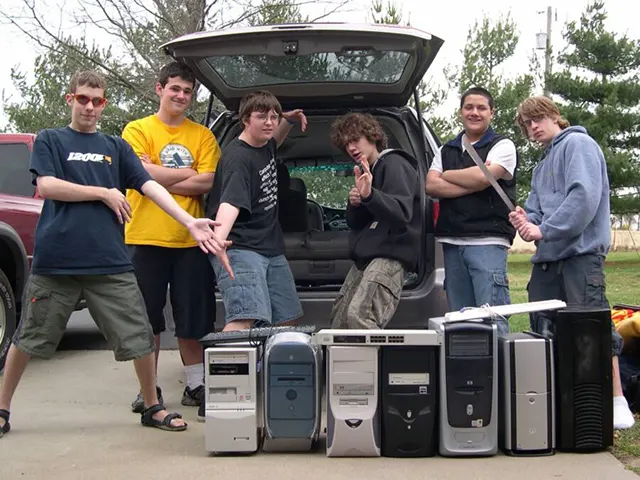
Fig 4. Image of players gathering equipment to travel to a LAN party.
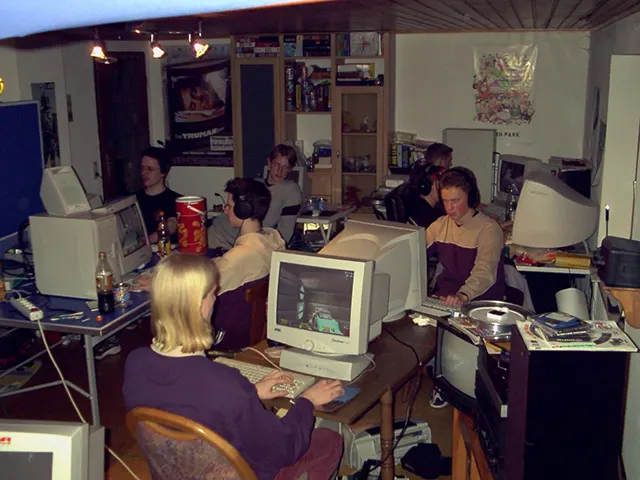
There was a very unique aesthetic to these LAN parties. Nest and tangles of cables, the sound of computers, and often fueled by pizza and caffeinated drinks. Gamers physically being in one location solved the latency issue which they all faced, while also allowing them to connect physically, humanizing who they were online.
|

|
> NEW_CHALLENGER: PRO_GAMING
The creation of LAN parties allowed tournaments to be held at a level playing field, removing the obstacles of connection and latency. ESports as a genre is something that has become widespread in today's age, but its origins can be traced back to the 90s. The birth of eSports is widely considered to be the Red Annihilation tournament which took place in May of 1997, during the E3 gaming convention. This was a Quake competition where Dennis “Thresh” Fong faced off against Tom “Entropy” Kimzer, cementing themselves as two of the pioneering names for the genre that is eSports.

Fig 7. Dennis "Thresh" Fong competing in a competition at Comdex .
> SYSTEM_ONLINE: PERSISTENT_WORLDS
By 1997, limitations from the early internet such as the “store-and-forward” methods were moving aside and giving way to “always-on” possibilities. With technological advancements such as Modem technology reaching speeds of 56 kilobytes per second, and an overall improvement to server architecture, one of the largest icons of online gaming was created, Massively Multiplayer Online Role-Playing Game (MMORPG). Before 1997, online games were simply “matches.” These were short bursts, that when over or when everyone logged out, would completely reset. It wasn’t until Ultima Online was created that it introduced persistence.

Fig 8. Ultima Online boxart logo.
The Ultima Series had originally begun as a title for Apple II in 1981, created by game designer Richard “Lord British” Garriott. The game had seen overwhelming success, leading to the creation of 8 installments in the Ultima Series. By the time the mid 90s rolled around, the Ultima Series had already been a reputable name in gaming circles. There was never any idea for this game to become more until DOOM had the creators realize “how much fun competitive online play could be” (Olivetti, 2022).
Garriott was very eager to take the Ultima Series to the next level and was pushing for development of Ultima Online: Shattered Legacy. The road was not very clear for them however, as their studios parent company, EA, didn’t feel like there was any profit within the MMO category, along with the worry that if this was unsuccessful, it could lead to the tarnishing of the Ultima Series brand as a whole. After heavy persistence from Garriott and his team, they were eventually given the go ahead to begin their work on this daring project.
After long development, Ultima Online was released to the public, but of course, not without some roadblocks along the way. Not only were they dealing with a launch full of server lag, instability, and bugs, they were also dealing with the issue of players “free will,” so to speak. “The idea was to give players a world that they could shape and roleplay as they saw fit,” (Olivetti, 2022) something that at the time, had not been done before. Because of players' freedom within the game, there were often many bugs which were exploited and found, that were very clearly not intended to occur. With this freedom, there were also issues involving excessive griefing, theft, and economic manipulation. Because Origin Studios wanted to give players a world they could shape themselves, it worked as a double-edged sword.
Fig 9. Short gameplay segment of Ultima Online
Over the time of its launch, Ultima Online’s team were able to suppress and solve many of these issues, while also taking into account that some of these moments were not necessarily all bad. All of these different actions players would ultimately create the first virtual society, with players creating their own unique virtual identities within the game. Ultima Online's legacy and impact also cannot be forgotten. Its creation and gameplay inspired many other very popular games today, including DayZ, Runescape, and one of the most successful and popular games of all time, World of Warcraft.
> SYSTEM_SHUTDOWN: CONCLUSION
The 1990’s laid the critical foundation for everything we experience currently in modern gaming. The evolution from dial-up modems, CRT monitors, and store-and-forwarding networking to modern day technology and infrastructure is a night and day experience, but the culture that technology was able to create still remains today. Social archetypes defined in early online gaming MUDs, the competitive and social spirit of early LANs, and the persistent world of MMOs like Ultima Online demonstrated that these virtual environments and experiences had real meaning. The 90’s gamers truly built one of the first online communities.
REFERENCES
- Austin, J. (2025, September 12). From Pong to the cloud: How internet performance shaped gaming history. Kinetic by Windstream.
- Bartle, R. (1996). Hearts, clubs, diamonds, spades: Players who suit MUDs. Journal of MUD Research, 1(1), 19.
- Claypool, M., & Claypool, K. (2006). Latency and player actions in online games. Communications of the ACM, 49(11), 40-45.
- DWANGO. (2024, May 2). In DoomWiki.org. Retrieved December 6, 2025, from https://doomwiki.org/wiki/DWANGO
- International Directory of Company Histories. (n.d.). CompuServe Interactive Services, Inc. Encyclopedia.com.
- Merritt K. (2019, July 5). Inside the world of 90s gamers and LAN party culture. Dazed.
- Nardi, T. (2025, March 6). Why 56k modems relied on digital phone lines you didn’t know we had. Hackaday.
- Norman, A. (1998). 56k page. University of Texas at Austin.
- Olivetti, J. (2022, September 3). The game archaeologist: How Ultima Online got made. Massively Overpowered.
- Olivetti, J. (2022, September 11). The game archaeologist: The legacy of Ultima Online. Massively Overpowered.
- omgomg53. (2006, December 21). Online Gaming History: The Sierra Network (ImagiNation) TV Ad - early 90's [Video]. YouTube.
- Red Annihilation. (n.d.). In Esports Fandom. Retrieved December 6, 2025, from https://esports.fandom.com/wiki/Red_Annihilation
- Serial Hobbyist. (2019, December 9). CompuServe price history. APL2BITS.
- Staff and Wire Reports. (1995, April 7). Prodigy introduces new pricing plan. The Spokesman-Review.
- Ages of Despair. (n.d.). Ages of Despair screenshots. Ages of Despair. https://www.agesofdespair.net/newbie/screenshots1.php
- Rare Historical Photos. (2025, January 15). The 2000s LAN party scene in photos: When gaming was all about local connections. https://rarehistoricalphotos.com/lan-parties-photos-2000s/
- ReadWorks. (n.d.). The first professional video gamer. Retrieved December 6, 2025, from https://www.readworks.org/article/The-First-Professional-Video-Gamer/6c4d4a3e-5e24-4318-8e3e-3f8a18c58523
- GVMERS. (2018, June 15). Ultima Online Retrospective. YouTube.
- Origin Systems. (1997, September 24). Ultima Online. Electronic Arts.